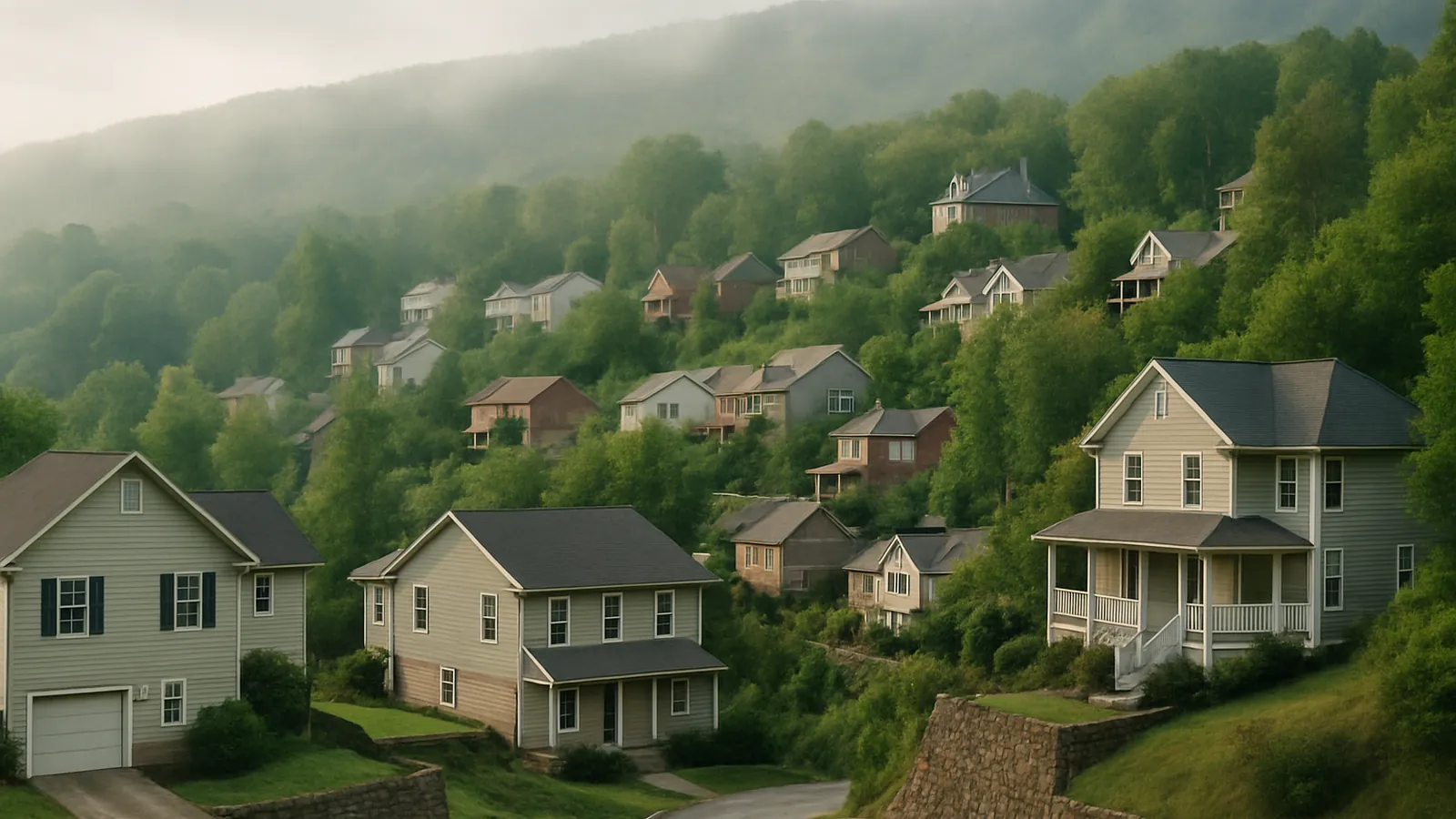
Foundation repair in Chattanooga costs $4,000–$15,000 for most full repairs, with piers $1,200–$3,000 each and drainage correction $1,500–$8,000. Roughly 54 inches of annual rain on Ridge-and-Valley slopes concentrates runoff against foundations — which is why water work usually comes first here.
Below: what the symptoms mean, why this terrain behaves the way it does, and how the repairs get sequenced.
What a moving foundation looks like from inside the house
Foundations rarely announce failure at the footing. The house above reports it first:
- Stair-step cracks through brick or block — masonry tracking a footing that dropped
- A cracked or pushed-in wall on the uphill side — the signature of slope pressure
- Doors and windows sticking, especially when it gets worse year over year
- Floors sloping toward one wall, or gaps opening under baseboards
- Water crossing the lot toward the house, or a crawl space that never dries
- A retaining wall leaning or bulging where it holds soil near the foundation
One symptom deserves a dated pencil mark and a season of watching. Two or more — especially if one of them is water — deserves a measured evaluation while the fix is still drainage rather than piers.
Ridge and Valley: the terrain is the mechanism
Chattanooga sits in the Ridge-and-Valley province, the belt of long parallel Appalachian ridges and valleys that runs through east Tennessee. Resistant rock holds up the ridges — Missionary Ridge, Stringer's Ridge, the wall of Walden Ridge and Lookout Mountain — while the valleys between them were carved into limestone and shale. Houses here get built on whatever ground is available, which frequently means cut into a slope.
Two things follow. First, water arrives with momentum and volume. Fifty-four inches a year is among the wettest in the state, and on a slope none of it sits and soaks evenly — it runs, it gathers, and it concentrates where the grade directs it. An uphill foundation wall can be receiving drainage from acres it doesn't own. Second, residual clay over bedrock means the soil column above rock varies sharply across a single lot: deep in one spot, shallow in another, which produces differential settlement without anything exotic happening.
The repairs that fix Chattanooga houses
| What you see | What's happening | The fix | Typical range |
|---|---|---|---|
| Water crossing the lot, wet crawl, soggy uphill side | Slope runoff concentrating at the foundation | Interception upslope and routing | $1,500–$8,000 |
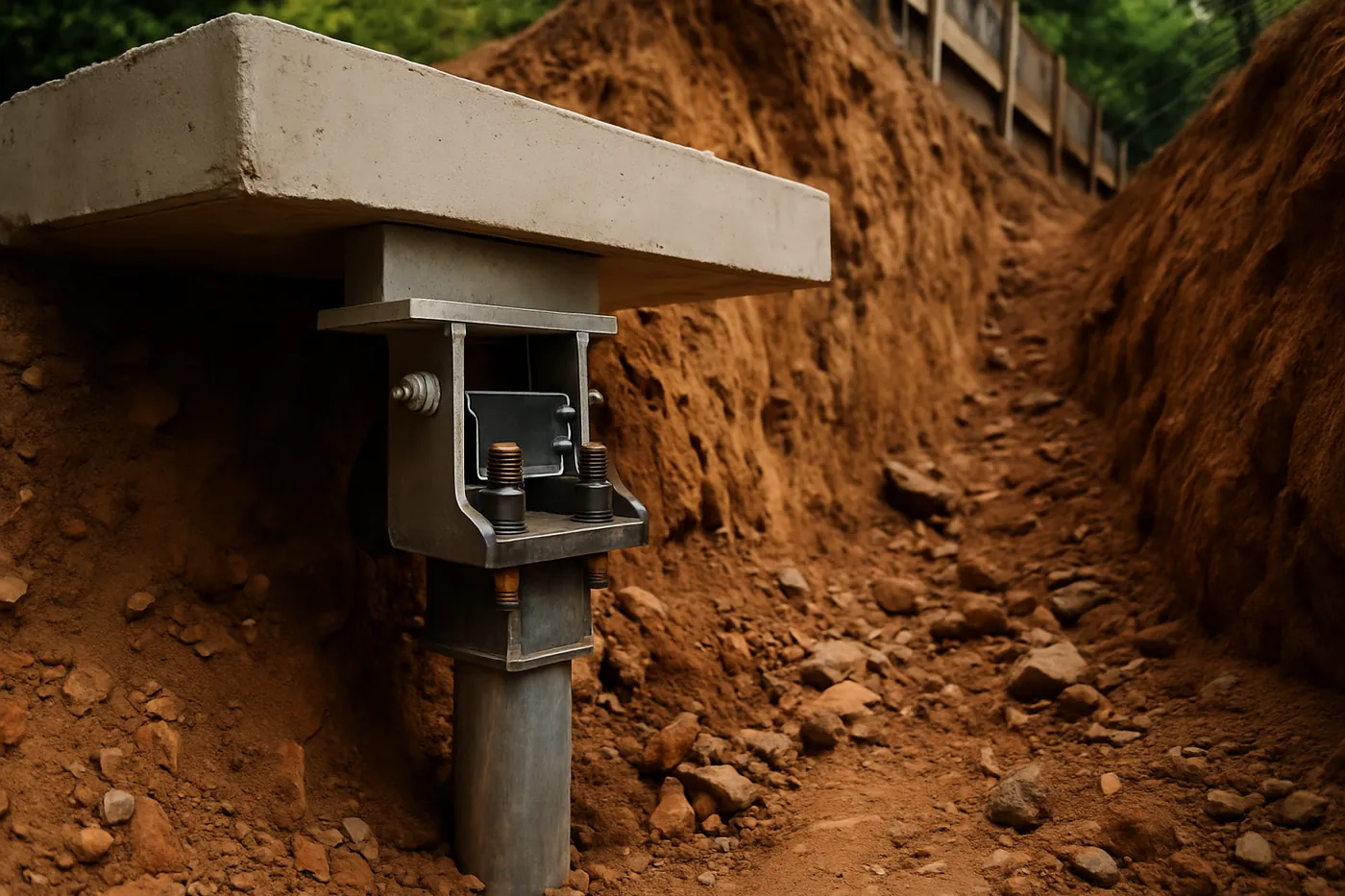
| Stair-step cracks, dropped corners, sloping floors | Footing settling where soil over bedrock is deeper or washed | Piers to rock or stable bearing | $4,000–$15,000 |
| Uphill wall cracked horizontally or pushed inward | Lateral soil and water pressure on a cut-slope wall | Carbon fiber, braces, or anchors | $2,500–$10,000 |
| Cracks leaking or widening | Movement or shrinkage opening a water path | Injection and reinforcement | $400–$1,500 |
| Retaining wall leaning, bulging, or shedding block | Saturated backfill with nowhere to drain | Drainage, anchors, or rebuild | $1,500–$12,000 |
Most hillside houses need two of these, not five — and here the order matters more than the selection does.
The decisions behind the table go deeper on their own pages: how we separate settlement from slope creep, when helical piers beat push piers on cut-and-fill lots, how hillside crawl spaces get dried, where exterior and interior waterproofing fit on a slope, what insurance excludes on hillsides, and when an independent structural engineer comes first.
Water first, and on a slope that means uphill
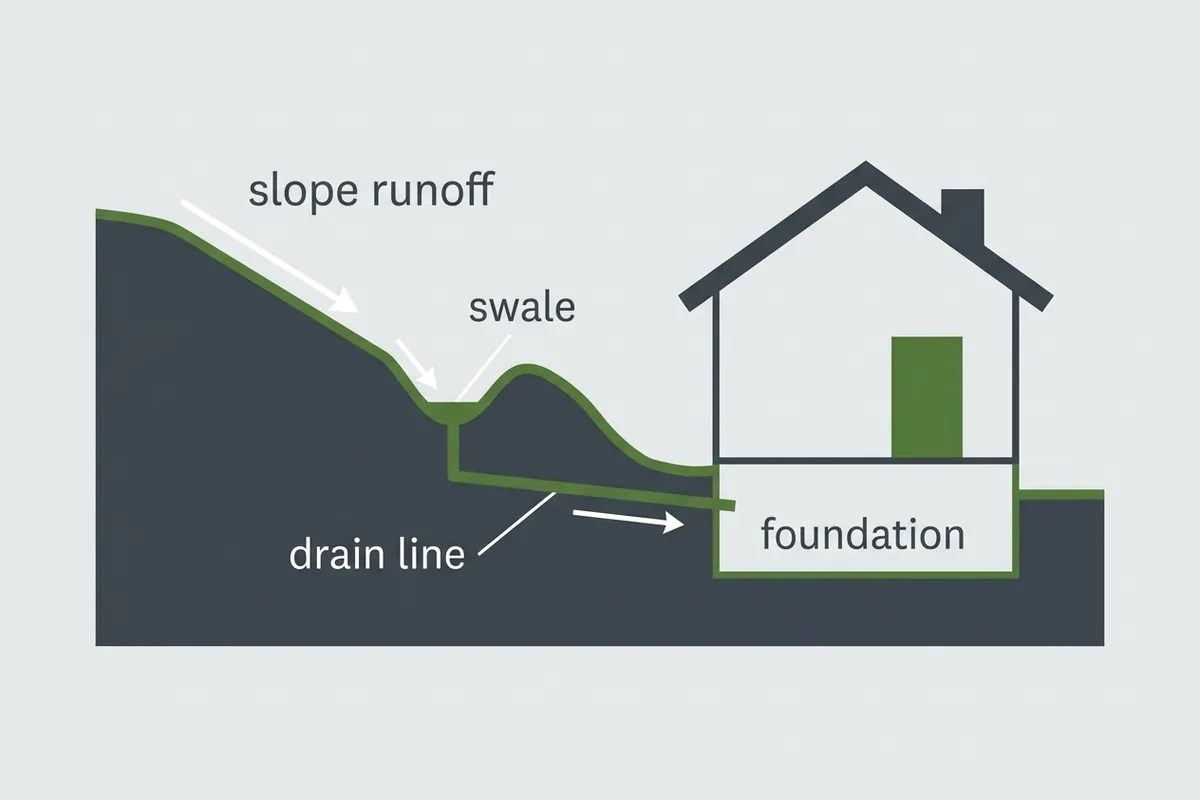
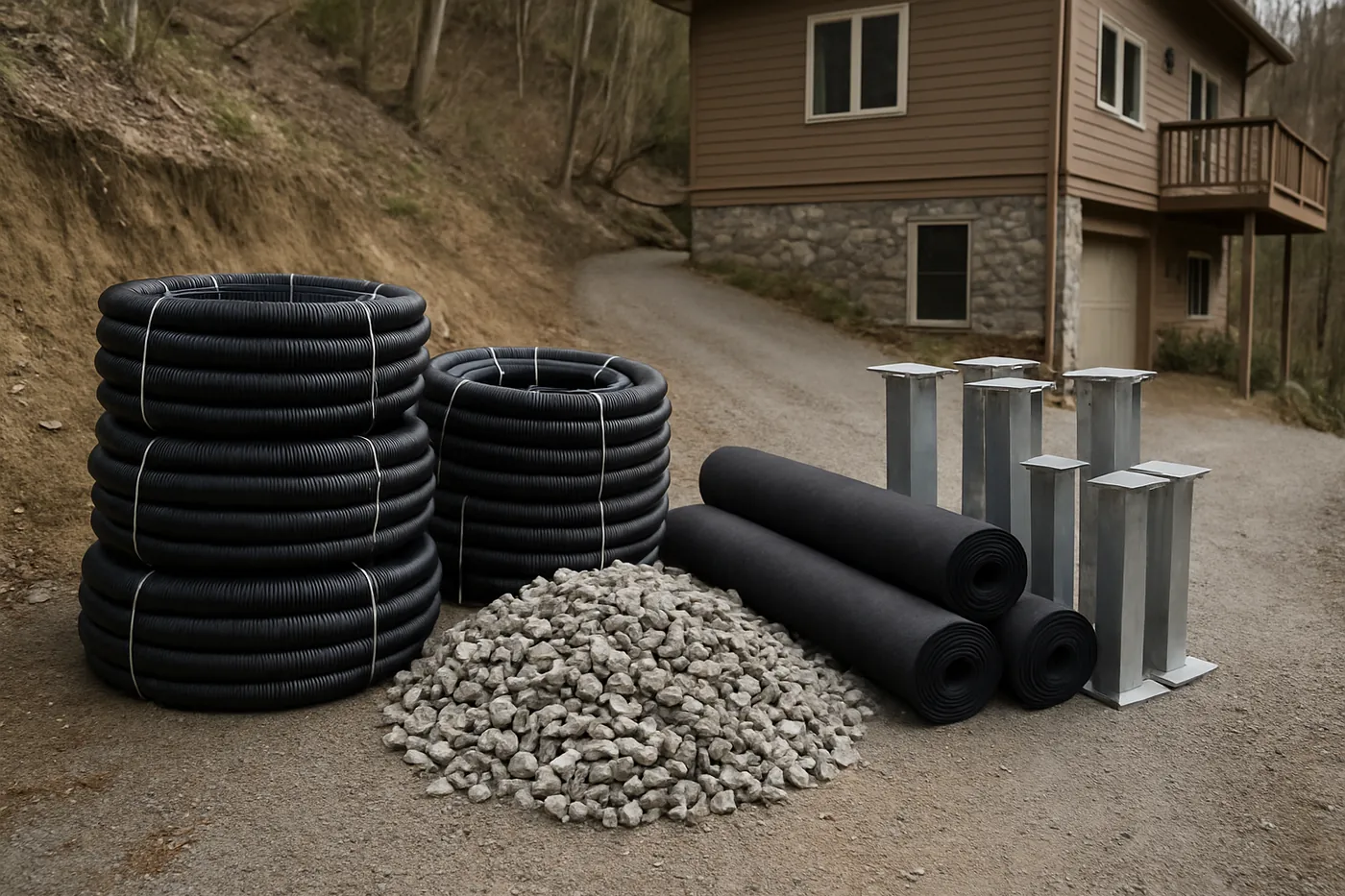
Every scope we write in this market puts water management ahead of structural steel, and on hillside lots it puts it above the house. The reason is mechanical: a brace resists a load, but if that load is a hillside delivering runoff into the backfill behind your wall every time it rains, the restraint spends its life fighting water that a swale or a drain line upslope would have removed for a fraction of the cost.
That's also why the cheapest lines appear first on our scopes — gutters, downspout extensions, a regraded swale above the house, a driveway edge that stops funneling water at the garage wall. On this terrain those aren't landscaping. They're the structural work.
Karst: the honest version
The limestone valleys around Chattanooga carry documented karst features — solution cavities, springs, and sinkholes formed as groundwater dissolved rock over geological time. Some local companies use that word as a sales lever. Here's the accurate framing: karst means groundwater can move in directions surface grading doesn't predict, which is worth knowing when a wet spot has no visible source. It very rarely means your house is above a void.
We diagnose the ordinary causes first — slope water, drainage, differential soil depth — because that's what the evidence shows on the overwhelming majority of lots. Where a pattern genuinely doesn't fit (localized, deep, unrelated to the drainage story), the right answer is a geotechnical referral, not a bigger pier package, and we'll tell you that plainly.
How the evaluation works
We shoot floor elevations with a laser, measure and photograph every crack, plumb any wall on a cut-slope side, and walk the lot uphill of the house — where the water comes from, what concentrates it, and where it goes. Retaining walls near the foundation get measured too. You get a written scope naming the cause, the sequence, the price per line, and the timeline — free, and yours to compare against any other bid.
Foundation questions Chattanooga homeowners ask
How much does foundation repair cost in Chattanooga?
Most full repairs run $4,000 to $15,000, with piers commonly $1,200 to $3,000 each, drainage correction $1,500 to $8,000, and crack repair from about $400. On hillside lots the drainage line is often the larger one, because slope water is usually what started the problem. Every figure follows a free measured evaluation. Our Foundation repair cost breakdown for Chattanooga shows what drives each figure, line by line.
Why is water such a big deal here?
Chattanooga gets roughly 54 inches of rain a year, among the wettest metros in Tennessee, and it lands on terrain with real slope. That combination means water doesn't sit — it moves, gathers momentum, and concentrates wherever the grade sends it. A foundation in the wrong spot on a hillside receives runoff from a lot more ground than its own.
My house is cut into a hill. Is that the problem?
The slope directs the water, and water is usually the problem. An uphill foundation wall holds back soil and takes every storm crossing the property above it — a load a level-lot house never experiences. Intercepting that water upslope typically accomplishes more, and costs far less, than anything applied at the wall itself.
What is karst and does it affect my foundation?
Karst is what happens when groundwater dissolves limestone, leaving solution cavities, springs, and sinkholes. The limestone valleys around Chattanooga carry documented karst features. For most homes it never becomes an issue, but it means groundwater here can travel in directions surface grading doesn't predict — and it's the reason a wet spot with no obvious source deserves a real look.
Should I worry about a sinkhole?
For the overwhelming majority of homes, no. Karst-related settlement is far less common than ordinary clay movement and slope water, and we diagnose the ordinary causes first because that's what the evidence usually shows. Where a pattern genuinely suggests a void — localized, deep, and not matching the drainage story — that's a geotechnical referral, and we'll say so rather than sell around it.
Do doors sticking in summer mean foundation trouble?
Sometimes, and sometimes it's humidity swelling the wood. The test is whether it fully reverses: mild seasonal sticking that comes and goes is usually the season. Sticking that gets worse year over year, or that arrives alongside new stair-step cracks or floors reading out of level, means something below moved.
Can a retaining wall failure affect my house?
It can, and on these lots it's worth taking seriously. A retaining wall holding soil above or beside a foundation is part of the structural picture — when it leans or fails, the soil it was holding redistributes, and that load has to go somewhere. Walls near a foundation get measured on the same visit.
Will homeowner's insurance cover this?
Usually not. Standard policies exclude earth movement and settling. Sudden events are the exception — a burst supply line washing out soil beneath a footing sometimes qualifies. We document cause and timeline during the evaluation in the format adjusters actually use, whichever way a claim goes.
Foundation repair across the Chattanooga area
East Ridge · Red Bank · Soddy-Daisy · Signal Mountain · Hixson · Ooltewah · Cleveland · Fort Oglethorpe · Ringgold · all service areas
Get a free Chattanooga foundation evaluation
Tell us what the house is doing — stair-step cracks, a wall pushed in on the uphill side, water crossing the lot, sloping floors — and we’ll schedule an evaluation with photos, measurements, and a walk of the slope. We reply the same business day.